How to Get Your Business Cited in ChatGPT, Gemini & Google AI Overviews
Want ChatGPT, Gemini and Google AI Overviews to mention your business? Here is what the platforms actually look for, and a practical plan to get cited in AI search for service and ecommerce brands.
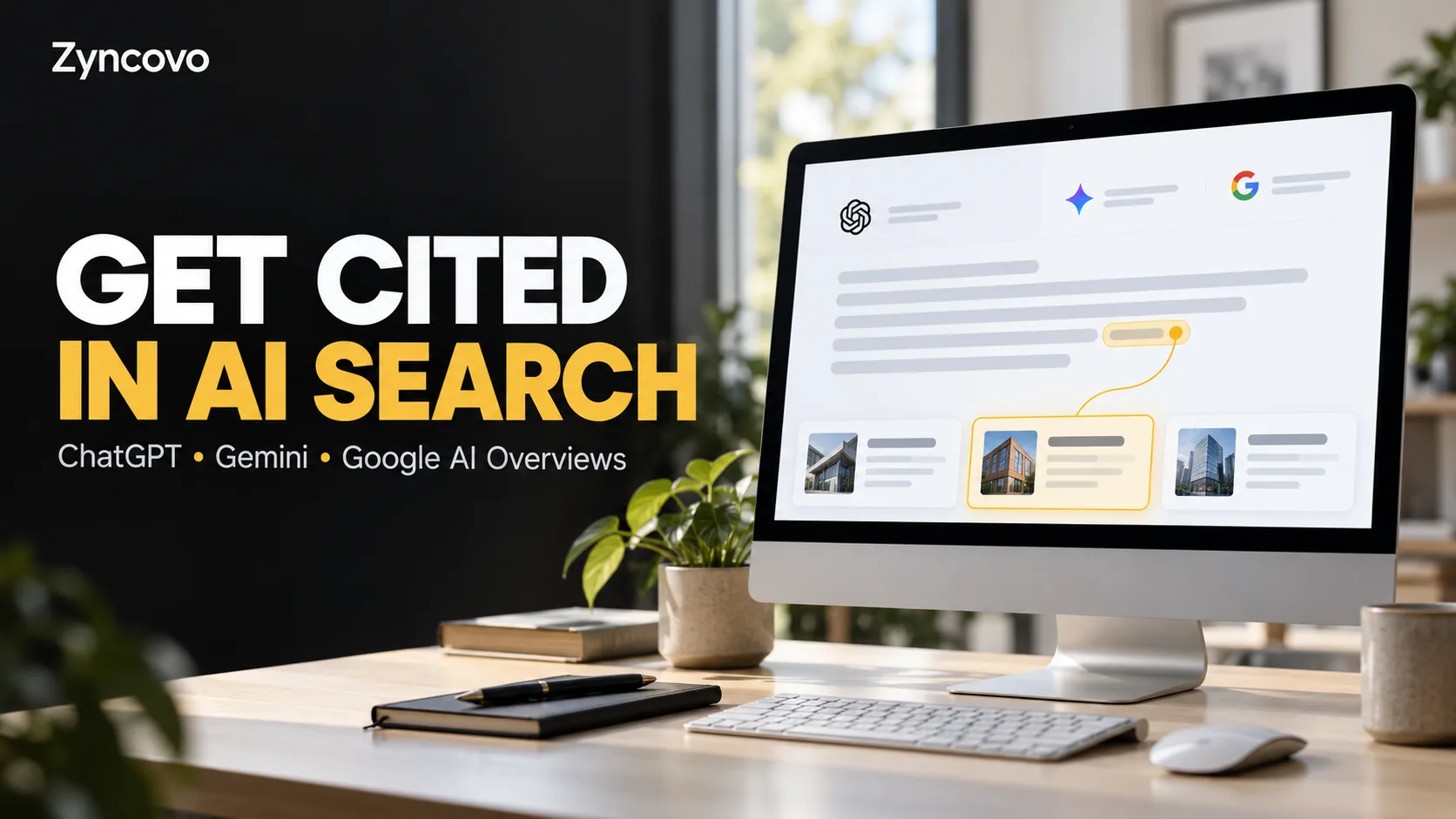
The short answer: to get cited in AI search, your business has to be easy for AI tools to find, understand and trust. In practice, that means four things:
- Be reachable. Let the right crawlers into your site and get your pages indexed in Google.
- Be quotable. Answer real customer questions clearly, with specific facts, prices, processes and data.
- Be consistent. Make sure your business name, services, location and details match everywhere: your website, Google Business Profile, directories and social profiles.
- Be talked about. Earn reviews, press mentions and listings on sites that AI tools already rely on.
There is no secret switch for AI search. Google says plainly that there are no extra requirements or special optimisations needed to appear in AI Overviews or AI Mode beyond being indexed and eligible to show a snippet (Google Search Central: AI features and your website). Good SEO is still the foundation. What changes is how your content needs to be written and where your brand needs to show up.
This guide explains how each platform picks its sources, then gives you a step-by-step plan for both service businesses and online stores. Nobody can guarantee a citation. But you can make your business a much easier choice.
How ChatGPT, Gemini and Google AI Overviews choose their sources
Each tool works a little differently, but they share one pattern: when a question needs current or specific information, they search the web first, then write an answer from the pages they found, and link to some of them as citations.
| Platform | Where answers come from | What you control |
|---|---|---|
| Google AI Overviews and AI Mode | Google’s own search index. Google says these features may use “query fan-out”, running several related searches across subtopics to build one answer | Being indexed, eligible for a snippet, and genuinely helpful for the question |
| Gemini app | Gemini models, with “grounding” that pulls content from the Google Search index at the time of the question | Your Google visibility, plus the Google-Extended setting in robots.txt |
| ChatGPT search | OpenAI’s search crawler, OAI-SearchBot, plus other search sources | Allowing OAI-SearchBot in robots.txt, and being easy to find and quote |
A few details matter more than most guides admit:
- Query fan-out changes what “ranking” means. If someone asks Google’s AI Mode “best HVAC company in Dallas for older homes”, it may run separate searches for reviews, older-home issues and local providers. A page that clearly answers one of those sub-questions can earn a link, even if it isn’t #1 for the main phrase.
- Google-Extended isn’t an SEO setting. Google states it controls whether your content is used to train Gemini models and for grounding in Gemini apps, and that it does not affect inclusion or ranking in Google Search (Google: common crawlers).
- OpenAI separates search from training. OpenAI says OAI-SearchBot is for search, while GPTBot is for training models. Sites that block OAI-SearchBot won’t appear in ChatGPT search answers (OpenAI: overview of OpenAI crawlers). You can block training and still allow search.
Why some businesses get cited and others don’t
Research backs up what we see in practice. In the KDD 2024 paper GEO: Generative Engine Optimization, adding citations, quotations and statistics to content improved its visibility in generative engine answers by up to 40%, while classic keyword stuffing gave little to no benefit (Aggarwal et al., arXiv).
The lesson for a business owner is simple. AI tools prefer content that sounds like evidence, not like an advert.
Step-by-step: how to get cited in AI search
Step 1: Make sure AI tools can actually reach you
This is the boring step, and it’s where many sites quietly fail.
- Your site is indexed in Google. Check key pages with the URL Inspection tool in Google Search Console.
- Your important pages don’t use
noindexornosnippet. Google needs to be able to show a snippet to use a page as a supporting link. - Your
robots.txtallows OAI-SearchBot if you want to appear in ChatGPT search. - Your firewall, CDN or security plugin isn’t blocking AI crawlers by default. Some hosting and bot-protection settings now do this automatically.
- Key information is in the HTML text, not only inside images, PDFs or scripts that load late.
Practical action: open yourdomain.com/robots.txt today. If you see Disallow: / under OAI-SearchBot or a blanket rule for all bots, you’ve found your first fix.
Step 2: Write pages that answer questions, not just pages that sell
AI answers are built from passages. A page that says “We offer quality plumbing services” gives an AI nothing to quote. A page that says “A standard 50-gallon water heater replacement usually takes 3 to 4 hours, and here’s what affects the price” is quotable.
For each core service or product category, create content that:
- Answers the question in the first two sentences, then explains
- Uses specifics: prices or price ranges, timelines, materials, service areas, warranty terms, sizes, compatibility
- Uses question-style headings that match how people ask (“How much does a furnace replacement cost in Dallas?”)
- Adds evidence: your own data, named sources, real examples, short expert quotes from your team
- Covers the follow-up questions a customer would ask next, so you match more of the fan-out searches
Step 3: Make your business an unmistakable “entity”
AI tools need to be confident about who you are before recommending you. Help them by keeping your core facts identical everywhere:
- Business name, address, phone and service area (exactly the same format)
- What you do, in one clear sentence, on your homepage and About page
- A complete Google Business Profile with correct categories, services, hours and photos
- Consistent profiles on Yelp, BBB, Apple Business Connect, Bing Places, Facebook and industry directories
- Organization or LocalBusiness structured data on your site, matching the visible text (Google notes structured data should match what’s on the page, and that no special schema is required for AI features)
Step 4: Get mentioned where AI tools already look
This is the step most “GEO” guides underplay. When someone asks ChatGPT “best roofer in Tampa” or “best organic dog food brands”, the answer often leans on third-party pages: review sites, “best of” lists, local news, Reddit threads and industry roundups. (Professional observation; test it yourself by checking which sources your own category’s AI answers cite.)
Ways to earn those mentions:
- Ask every happy customer for a Google review, and reply to reviews with specifics
- Get listed in relevant “best of” roundups and local directories
- Share useful data or opinions with local journalists and industry publications
- Take part in community discussions (Reddit, Quora, Facebook groups) as a helpful expert, not a salesperson
- For ecommerce: get product reviews from real publications and creators in your niche
Step 5: Show real experience (E-E-A-T)
Google’s quality guidance talks about experience, expertise, authoritativeness and trust. In AI search, these show up as concrete signals:
- Real author names and bios on articles, with relevant credentials or years in the trade
- Original photos of your work, team and products
- Case studies with real (permission-approved) results, like our Quick Fix Appliance Experts case study
- Clear contact details, licences, insurance and policies
Step 6: Keep content fresh
Prices, regulations and products change. Update key pages a few times a year, and show a visible “last updated” date. Outdated prices are a fast way to lose trust, with humans and AI alike.
Service businesses vs online stores: what to focus on
The same principles apply to both, but the priorities differ.
| Local service business | Ecommerce store | |
|---|---|---|
| Typical AI question | “Best emergency plumber near me”, “Who installs heat pumps in Denver?” | “Best waterproof hiking boots under $150”, “Is [brand] legit?” |
| Biggest lever | Google Business Profile, reviews, local citations | Product detail, comparisons, third-party reviews |
| Content to create | Service pages with prices, process, service area and FAQs; cost guides | Buying guides, comparison pages, size/fit and compatibility info |
| Structured data | LocalBusiness, Service, FAQ (where it matches the page) | Product, Offer, Review, Organization |
| Trust signals | Licences, insurance, years in business, real job photos | Returns policy, shipping info, real customer photos, brand story |
For service businesses: AI answers for local questions lean on the same signals as local search. A complete, active Google Business Profile with steady, detailed reviews is one of the strongest things you can control. Ask customers to mention the service and area in their review (“replaced our water heater in Katy the same day”); it gives AI tools specific facts to repeat.
For ecommerce: product pages with only a manufacturer description are invisible in AI answers, because hundreds of other sites say the same words. Add what only you know: real-world use notes, sizing advice from returns data, honest pros and cons, and comparisons with alternatives. That’s the information gain AI tools look for.
How to measure your AI search visibility
At the time of writing, Google Search Console reports AI Overview and AI Mode traffic inside the normal Web search report, without a separate filter, and ChatGPT and Gemini offer no business dashboard at all. So measure it in a few practical ways:
- Manual prompt checks. Write down 10 to 20 questions your customers actually ask. Once a month, ask them in ChatGPT, Gemini and Google (with AI Overviews). Record whether you’re mentioned, cited with a link, or missing, and which competitors and sources appear instead.
- Referral traffic in GA4. Check Traffic acquisition for referrals from chatgpt.com, gemini.google.com, perplexity.ai and copilot.microsoft.com. It’s usually small, but it’s a direct sign of citations. If your GA4 setup needs work, our tracking and analytics team can help.
- Branded search growth. People often see a brand in an AI answer, then Google it. A rise in branded searches in Search Console can be an indirect signal.
- Ask new customers. Add “ChatGPT / AI assistant” as an option in your “How did you hear about us?” form or call script.
Dedicated AI visibility tools exist too, and they’re improving quickly. But a simple monthly spreadsheet of real prompts is enough for most small and mid-sized businesses to start.
Common mistakes and myths
- “I need a special AI schema or an llms.txt file to get cited.” Google says no special structured data is needed for AI features. Files like llms.txt are a proposed convention, not something Google or OpenAI document as a requirement. They won’t hurt, but they’re not a shortcut.
- Blocking every AI bot “to be safe.” If you block OAI-SearchBot, you opt out of ChatGPT search. Decide separately on training bots (like GPTBot and Google-Extended) and search bots.
- Writing for robots instead of people. Stuffing “best AI-ready plumber” into every paragraph doesn’t help. The GEO research found keyword stuffing gave little to no benefit in generative engines.
- Only working on your own website. Many AI answers about “best” providers cite reviews, lists and forums. If you’re absent there, your website alone may not be enough.
- Inconsistent business details. An old address on a directory or a different business name on social media makes you a riskier recommendation.
- Chasing quick tricks. Buying fake reviews or spamming forums can break platform policies and damage trust. It’s not worth it.
- Expecting instant results. Crawling, indexing and third-party mentions take time. Think in months, not days.
When to get professional help
You can start on most of this yourself: check robots.txt, tidy up your Google Business Profile, rewrite your top service or category pages, and run monthly prompt checks.
It makes sense to bring in a specialist when:
- You’re not sure whether your site, hosting or security settings are blocking crawlers
- Your content needs a proper rebuild around customer questions
- You want structured data, local SEO and review strategy handled together
- Competitors keep appearing in AI answers for your category and you can’t see why
At Zyncovo, our SEO team treats AI search as part of SEO, not a separate trick: technical access, helpful content, consistent local signals and real third-party mentions.
Want to know how AI tools see your business today? Explore our SEO services or contact our team for an AI search visibility review.
Frequently asked questions
Can I pay to get my business cited in ChatGPT or Google AI Overviews?
No. Citations in ChatGPT answers and Google AI Overviews are organic. Some platforms are testing ads in or around AI answers, but those are labelled ads, not citations. The only way to earn a citation is to be a useful, trustworthy source.
Is getting cited in AI search different from SEO?
It’s built on SEO, not a replacement for it. Google says pages need to be indexed and eligible for a snippet to appear in AI Overviews. What’s different is the emphasis: clear answers, specific facts and third-party mentions matter more than exact-match keywords.
What is generative engine optimization (GEO)?
GEO is the practice of making your content more likely to be used and cited by AI tools that generate answers, such as ChatGPT, Gemini and Google AI Overviews. The term comes from a 2023 research paper later published at KDD 2024. You’ll also hear AEO (answer engine optimization) and AI SEO used for similar work.
Should I block AI crawlers?
It depends on your goal. Blocking OAI-SearchBot removes you from ChatGPT search results. Blocking GPTBot or Google-Extended limits use of your content for model training, and Google says Google-Extended doesn’t affect Google Search. Many businesses allow search crawlers and make a separate choice about training.
How long does it take to get cited in AI search?
There’s no fixed timeline. Technical fixes like robots.txt can take effect within days, while content improvements, reviews and third-party mentions usually take months to build up.
Do reviews help with AI search visibility?
For local businesses, very likely yes. AI answers to best near me questions often draw on review platforms and Google Business Profile information, so a steady flow of detailed, genuine reviews is one of the most useful things you can build.
Ready to build your growth engine?
Book a free audit. We'll review your ads, SEO, website, and tracking, and hand you a clear, prioritized plan, whether or not you work with us.