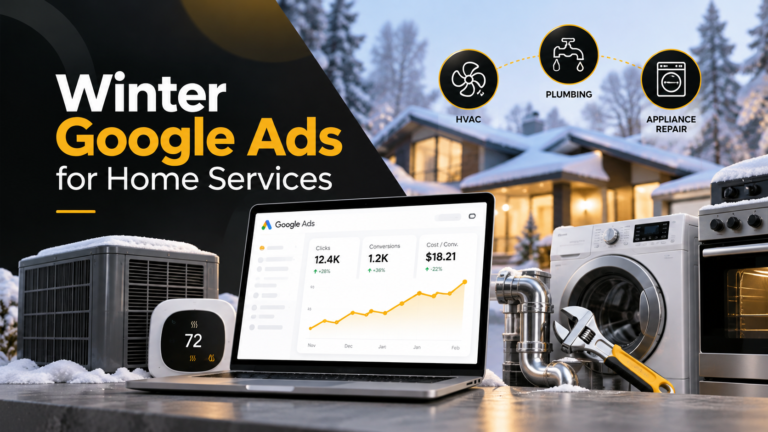
How Home Service Businesses Should Adjust Google Ads for Winter (HVAC, Plumbing, Appliance Repair)
Cold snaps change what homeowners search for overnight. Here is how HVAC, plumbing and appliance repair companies should adjust Google Ads budgets, keywords, bids and call handling for winter.
The short answer: to adjust Google Ads for winter, plan for search demand to shift from planned jobs to urgent ones, often moving with the weather rather than the calendar. To win those calls, home service businesses should:
- Shift budget toward emergency and heating keywords before the first hard freeze, not after it.
- Keep enough budget in reserve to spend more for a few days when a cold snap hits.
- Rewrite ads around speed (“same-day”, “24/7”, “no heat? we’re on the way”).
- Make sure someone actually answers the phone, including nights and weekends.
Winter is when a furnace that limped through last year finally quits, pipes freeze, and the oven gives up a week before the family arrives for the holidays. The homeowner isn’t comparing five quotes. They’re calling whoever shows up first and looks trustworthy. Your Google Ads setup decides whether that’s you.
Below is how each trade changes in winter, and the exact adjustments to make in your account.
How winter changes search demand for each trade
Winter doesn’t affect every home service business the same way. Before changing anything, know which way your demand moves.
| Trade | What homeowners search for in winter | What usually drops | Main trigger |
|---|---|---|---|
| HVAC | Furnace repair, no heat, heat pump not working, boiler repair, emergency heating repair | AC repair, AC installation | First cold nights and sudden temperature drops |
| Plumbing | Frozen pipes, burst pipe, water heater repair, no hot water, emergency plumber | Some planned remodel work | Hard freezes, especially in areas not used to them |
| Appliance repair | Oven repair, dryer repair, refrigerator repair, washer repair | Very little, demand is steadier | Holiday cooking and family visits (Thanksgiving to New Year) |
This table reflects our professional judgement based on the nature of each service. Check your own search terms report and Google Trends for your city to confirm the pattern.
Why the weather matters more than the date
For HVAC and plumbing, the calendar is only a rough guide. A warm December can stay quiet, then one cold front can bring a week of work in three days.
Pipes are a good example. The U.S. Department of Energy notes that southern states generally start having frozen pipe problems at around 20°F (Energy Saver, U.S. Department of Energy). That’s why a freeze in Texas or Georgia can bring a sudden wave of emergency plumbing searches, while homes in colder states are built for those temperatures.
Practical action: pull last winter’s daily calls and conversions from Google Ads and line them up against the local weather history. You’ll usually see your own trigger temperature. That number is worth more than any industry average.
Budget and bidding: how to adjust Google Ads for winter cold snaps
Raise budgets slightly before demand peaks, and keep a reserve for the spikes. One of the most common winter mistakes we see is a fixed daily budget that runs out by mid-morning on the coldest day of the year, while competitors keep getting calls until midnight.
Set a winter baseline, then a surge plan
- Baseline budget: what you need on a normal winter day. Start from last winter’s average daily spend and cost per lead, not from your summer numbers.
- Surge budget: what you’re willing to spend per day during a freeze or cold snap. Agree this in advance, so you’re not deciding at 7am while the phones are ringing.
- Capacity limit: the most jobs your techs can realistically handle. There’s no point paying for leads you can’t serve within a day.
That third point gets ignored a lot. If your team is fully booked for three days, more ad spend just produces frustrated callers and bad reviews. Spend on the calls you can take.
Use seasonality adjustments carefully
If you use Smart Bidding (Target CPA or Target ROAS), Google has a tool built for short spikes: seasonality adjustments. You tell Google you expect conversion rates to change for a set period, and bids react straight away instead of waiting to learn.
Google’s guidance is specific: they’re designed for short events of 1 to 7 days, may not work well beyond 14 days, and should only be used when you expect a major change, because Smart Bidding already handles normal seasonality (Google Ads Help: About seasonality adjustments).
That makes them a good fit for a forecast hard freeze, and a poor fit for “it’s winter now.” Don’t set one for the whole of December.
If you use manual or Maximize Clicks bidding
Many smaller home service accounts still run Manual CPC or Maximize Clicks. In that case, raise bids on emergency ad groups (no heat, burst pipe) during cold spells, and lower them on planned work (AC tune-ups, new installs) that won’t convert in January anyway.
Winter keywords, negative keywords and ad copy
Keywords to prioritise
Group these into their own ad groups (or campaigns, if budget allows), so you can control spend on emergencies separately from routine work.
- HVAC: furnace repair near me, no heat in house, heater not working, heat pump repair, boiler repair, emergency furnace repair, furnace replacement cost
- Plumbing: frozen pipe repair, burst pipe plumber, emergency plumber near me, no hot water, water heater repair, water heater replacement
- Appliance repair: oven not heating, oven repair near me, refrigerator not cooling, dryer not heating, washer repair same day
Use phrase and exact match for the emergency terms. Broad match can work with Smart Bidding and good conversion data, but in a short cold snap there’s little time for it to learn, and wasted clicks cost more than usual.
Negative keywords to check before winter
- DIY terms: “how to”, “thaw pipes yourself”, “reset furnace”, “youtube”, “diy”
- Jobs and training: “jobs”, “salary”, “technician course”, “apprenticeship”
- Parts shoppers: “part number”, “igniter”, “thermocouple”, “buy” (unless you sell parts)
- Summer services you’ve paused: “ac install”, “ac tune up”
A quick tip: on cold days, many people search for DIY fixes first. Check your search terms report every day or two during a freeze. Wasted spend shows up fast.
Ad copy that matches a winter emergency
Someone with no heat at 9pm isn’t reading about your 20 years of experience. They want three answers: can you come today, do you cover my area, and can I trust you.
| Generic headline | Winter-ready headline (under 30 characters) |
|---|---|
| Quality HVAC Services | No Heat? Same-Day Repair |
| Experienced Local Plumbers | Frozen Pipe? 24/7 Plumber |
| Appliance Repair Experts | Oven Broken? Same-Day Repair |
| Call Us Today | Techs Available Tonight |
Use the descriptions (up to 90 characters) for the extra detail, for example: “Broken oven before the holidays? Local techs, upfront pricing, same-day slots available.”
Only promise what’s true. If you don’t offer 24/7 service, don’t say it. A misleading ad wastes the click and earns a bad review.
Also update your assets (formerly extensions): call asset, location asset, sitelinks for “Emergency Service” and “Financing” (for furnace or water heater replacements), and callouts like “Upfront Pricing” or “Licensed & Insured”.
Location, ad schedule, Local Services Ads and calls
Tighten your service area
In a freeze, your techs are slower. Roads are worse and every job takes longer. Consider shrinking your location targeting to the areas you can reach quickly, or lowering bids on the outer edge of your area. A lead you can’t reach until tomorrow often goes to a competitor anyway.
Check that location targeting is set to “Presence: people in or regularly in your targeted locations”, not “Presence or interest”. Otherwise you can pay for clicks from people searching about your city from somewhere else.
Adjust your ad schedule to your real availability
Winter emergencies happen at night and on weekends. If you offer after-hours service, run ads then and consider higher bids for those hours. If you don’t, pause the ads or switch them to call-focused ads only during hours you can still answer, so you’re not paying for calls that go to voicemail.
Run Local Services Ads alongside Search
For HVAC and plumbing in the US, Local Services Ads (LSAs) often show above regular search ads. You pay per lead (a call or message), not per click, and eligible home service businesses can earn the Google Verified badge (which replaced the older Google Guaranteed badge) after Google’s screening checks (Google Ads: Local Services Ads).
In winter, LSAs and Search work well together: LSAs catch the “near me” emergency searches, and Search campaigns give you control over keywords, ad copy and landing pages. Increase the LSA budget ahead of the cold months, and mark leads as booked or not inside the LSA dashboard so you know which channel is really producing jobs.
The phone matters more than the ad
This is the part most guides leave out. In winter, most urgent leads come in by phone rather than forms (that’s our experience across home service accounts), and a missed call is a lost job. Before increasing spend:
- Track calls from ads as conversions (Google forwarding numbers or a call tracking tool), with a minimum call length so short hang-ups don’t count. Our conversion tracking checklist walks through the setup.
- Listen to a sample of calls each week. Are they answered? Booked?
- Set up an after-hours answering service or overflow line if your office closes at 5pm.
- Make sure the landing page has a click-to-call button above the fold on mobile.
Month-by-month checklist to adjust Google Ads for winter
When you adjust Google Ads for winter, match the timing to your climate. A contractor in Atlanta and one in Chicago won’t have the same first freeze.
October to early November: prepare
- Review last winter’s search terms, calls and cost per lead
- Build or refresh emergency ad groups (no heat, frozen pipes, oven repair)
- Update negative keyword lists
- Write winter ad copy and assets; pause summer offers
- Raise your Local Services Ads budget and check your service areas
- Test call tracking and conversion tracking
- Agree baseline and surge budgets with the owner
November to December: shift and watch
- Move budget from AC and planned work to heating and emergency campaigns
- Promote holiday-related appliance repair (ovens, ranges, refrigerators)
- Watch weather forecasts weekly for the first hard freeze
- Check search terms every few days
January to February: react fast
- On a forecast freeze: apply a seasonality adjustment (if on tCPA/tROAS) or raise budgets and bids on emergency ad groups
- Extend your ad schedule into evenings and weekends if you can answer
- Pull budget back once the cold snap ends and conversion rates normalise
- Promote replacements (furnaces, water heaters) with financing to customers whose systems failed
March: wind down and plan ahead
- Shift budget back toward AC tune-ups and spring maintenance
- Save notes on what worked: trigger temperatures, surge spend, cost per booked job
Want a deeper, trade-by-trade breakdown? Read our full guide to winter Google Ads strategy for home services.
Common winter Google Ads mistakes
- Cutting budget in December because “it’s the holidays.” For HVAC and plumbing, holiday weeks can bring some of the most urgent calls. Check your own data before going quiet.
- Running the same ads all year. “Schedule your AC tune-up” in January wastes impressions and lowers click-through rate.
- Letting budgets cap out on the coldest days. The day you most need to be visible is the day a fixed budget runs out first.
- Using long seasonality adjustments. Setting one for the whole winter goes against Google’s own guidance and can confuse Smart Bidding.
- Counting every call as a lead. Wrong numbers, spam and existing customers inflate results. Use call length and lead quality checks.
- Paying for leads you can’t serve. If the schedule is full for three days, more spend just creates unhappy callers.
- Ignoring appliance repair seasonality. It’s steadier than HVAC, but holiday cooking and family visits still change which appliances break and how fast people want them fixed. See how we approach this in our appliance repair case study.
When to bring in a Google Ads specialist
You can make most of these changes yourself. Getting outside help makes sense when:
- You’re spending enough that a few wasted days during a freeze cost real money
- You don’t have time to watch search terms and forecasts while running jobs
- Your cost per lead rises every winter and you can’t see why
- You want call tracking, conversion tracking and Smart Bidding set up properly before the season starts
At Zyncovo, we manage Google Ads for home service businesses with a simple rule: prepare before the cold arrives, react fast when it does, and only pay for leads your team can actually take.
Want your account ready before the first freeze? Take a look at our Google Ads management services, or contact our team for a winter account review.
Frequently asked questions
Should HVAC companies increase Google Ads budget in winter?
Usually yes, for heating and emergency services, especially in colder regions. Increase it before the first cold nights rather than after, and keep a reserve for cold snaps. Reduce spend on AC services at the same time, so total budget doesn’t need to rise as much as you’d think.
When should home service businesses start winter Google Ads campaigns?
Most US home service businesses should have winter campaigns ready by late October or early November. In southern states, where freezes are less predictable, have them built and paused, ready to switch on when a freeze is forecast.
Are Google Ads worth it for plumbers in winter?
Winter is one of the best times for plumbing ads, because frozen and burst pipe searches are urgent and high-value. The key is fast response: an emergency lead is only worth something if you can get a plumber there quickly.
What are seasonality adjustments in Google Ads?
They’re a setting that tells Smart Bidding to expect a conversion rate change for a short period, such as a 3-day freeze. Google recommends them for events of 1 to 7 days, and only when you expect a major change.
Should appliance repair companies change their Google Ads in winter?
Yes, but less dramatically than HVAC or plumbing. Promote oven, range and refrigerator repair before Thanksgiving and the December holidays, and use same-day messaging when your schedule allows it.
Do Local Services Ads work better than regular Google Ads in winter?
They do different jobs. Local Services Ads charge per lead and show a Google Verified badge, which is strong for near me emergency searches. Search ads give you more control over keywords and messaging. Most HVAC and plumbing companies get the best results running both.
Ready to build your growth engine?
Book a free audit. We'll review your ads, SEO, website, and tracking, and hand you a clear, prioritized plan, whether or not you work with us.